
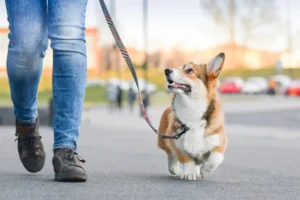
Walking with your dog should be a moment of shared enjoyment. However, if your companion constantly pulls on the leash, this activity can quickly become exhausting and frustrating. You are not alone in this situation: nearly 70% of dog owners face this problem daily.
Fortunately, there are effective and animal-friendly solutions. In this article, discover 5 gentle methods that will transform your walks into enjoyable moments for both of you.
Why does my dog pull on the leash?
Before correcting this behavior, it is essential to understand why your dog pulls. This habit is not a whim but responds to specific natural needs.
The instinct to explore
Dogs have a sense of smell 40 times more developed than ours. Each walk represents a true sensory adventure for them. The smells naturally draw them forward, creating that tension on the leash you know so well.
The excitement of going out
After several hours indoors, your dog is bursting with energy. This excitement translates into an irresistible urge to move quickly to explore their environment. This is especially true if outings are rare or too short.
Unintentional learning
Paradoxically, we sometimes reinforce this behavior without realizing it. When your dog pulls and you follow, they learn that pulling works to get what they want. It’s a vicious cycle that gradually sets in.
The negative consequences of pulling on the leash
Allowing your dog to pull on the leash is not without risks, both for the animal and the owner.
For your dog, the constant pressure on the neck can compress the trachea and cause respiratory problems. The cervical vertebrae also undergo repeated stress, which can lead to chronic pain. Not to mention the stress and frustration generated by the inability to explore freely.
For you, the consequences are also felt: excessive physical fatigue in the arms and back, risk of falling during sudden jerks, and above all, the pleasure of the walk evaporates in favor of stress.
Method 1: The immediate stop technique
This first approach involves stopping as soon as your dog pulls. The idea is simple but remarkably effective: you become an immobile “tree”.
Specifically, stop immediately when the leash tightens, without pulling back. Wait patiently for your dog to come back to you or relax the leash. As soon as they do, reward them with a treat and warm praise, then resume walking.
This technique teaches your dog that pulling literally gets them nowhere, while walking calmly allows progress. Be patient: in the beginning, you may be standing still, but results usually come within 2 to 3 weeks of regular practice.
Method 2: Strategic change of direction
Surprise your dog by becoming unpredictable. This method involves suddenly changing direction as soon as your companion starts to pull.
Observe the moment the tension appears on the leash, then immediately turn around while calling your dog in a cheerful voice. When they join you, reward them generously. Then vary the directions to keep their attention on you rather than the environment.
The advantage of this approach is twofold: it develops your dog’s attention towards you and reinforces your position as the walk’s guide. Your dog learns that they need to watch you to know where you are going, rather than deciding the direction on their own.
Method 3: Rewarding walking at heel
Transform relaxed leash walking into an ultra-positive experience. Instead of just correcting bad behavior, this method actively rewards good behavior.
Hold high-value treats in your free hand and reward immediately whenever your dog walks beside you. Use a keyword like “heel” or “with me” to create a positive association. Gradually reduce the frequency of treats while maintaining verbal praise.
The goal is to associate walking at heel with great experiences. Your dog will quickly understand that staying close to you is much more interesting than pulling ahead.
Method 4: Pre-walk exercise
A tired dog pulls less on the leash. This often-overlooked method involves expending your companion’s energy before the educational walk.
Organize 10 to 15 minutes of intense exercise in your yard or at home. This can be a game of fetch, an improvised obstacle course, or even mental exercises like searching for hidden treats. Then allow 5 minutes of calm for your dog to recover, and then start your educational walk.
A dog that has released its excess energy will naturally be more receptive to learning and less tempted to rush towards every external stimulation.
Method 5: Using a no-pull harness
The right equipment can significantly ease training. A no-pull harness distributes pressure across the chest rather than the fragile neck, while naturally discouraging pulling through its mechanism.
Choose a model with breathable, padded materials, adjustable straps, and reliable safety buckles. The fit is crucial: you should be able to fit two fingers under the straps while allowing freedom of movement for the front legs.
The transition should be gradual. First, let your dog get used to the harness at home, then start with short walks, gradually increasing the duration. Always associate wearing the harness with positive experiences.
Common mistakes to absolutely avoid
Certain instinctive reactions can worsen the problem. Pulling on the leash creates opposition that reinforces your dog’s behavior. Yelling or getting angry increases their stress and excitement. Choke collars, on the other hand, can cause serious injuries.
The key to success lies in calmness, patience, and consistency. Reward every small progress and adapt your approach to your dog’s unique temperament.
How to optimize your dog’s learning
Short but regular sessions of 10 to 15 minutes are more effective than a long weekly session. Start in a controlled environment like your yard, then progress to more stimulating areas.
Depending on your dog’s temperament, expect to see lasting results in 2 to 8 weeks. Patience is your best ally in this educational adventure.
Special cases by age and size
Puppies learn faster but have less concentration. Favor very short sessions with frequent rewards. For senior dogs, be even more patient as habits are more entrenched. Large dogs may sometimes require the help of a professional dog trainer due to their strength.
When to consult a professional dog trainer?
If after 3 months of regular efforts no improvement is visible, or if your dog shows aggressive behaviors on the leash, do not hesitate to consult a dog trainer. They can identify specific causes and propose a personalized program.
The importance of family consistency
All family members must apply the same rules. Use the same keywords, adopt the same attitude towards pulling, and reward in the same way. This consistency prevents confusing your dog and significantly speeds up learning.
Conclusion: Rediscover the joy of walking
Teaching your dog not to pull on the leash requires patience, consistency, and the right techniques. The 5 methods presented give you the keys to transform your walks into moments of shared enjoyment.
Remember that every dog is unique. Feel free to combine several approaches based on your companion’s reactions. With perseverance, you will soon rediscover the joy of walking together, in mutual respect and companionship.
Walking will become what it should be: a special moment of sharing and discovery with your faithful companion.